
The Capital Regional District (CRD), made up of 13 member municipalities from southern Vancouver Island and the Gulf Islands, has passed a Canada Goose Management Service, which will include a cull, despite not having done their due diligence on non-lethal methods of habitat modification and false reporting of population estimates. Animal Alliance of Canada is advising against a cull as they will not resolve conflict, population issues, and are inhumane.
In its 2022 Canada Goose Mitigation Draft Action Plan, prepared by Guardian of the Mid-Island Estuary Society for the CRD, they state, “The CRD developed a Canada Goose Management Strategy in 2012 but has not actively worked to implement key mitigation activities in recent years.” Clearly, they have not done their due diligence at this point to justify a cull.
- In 2012 RCGMS, Christmas Bird Counts data provides that annual growth is between 10-11% and the then current population is estimated at 5,000 non-migratory resident Canada geese.
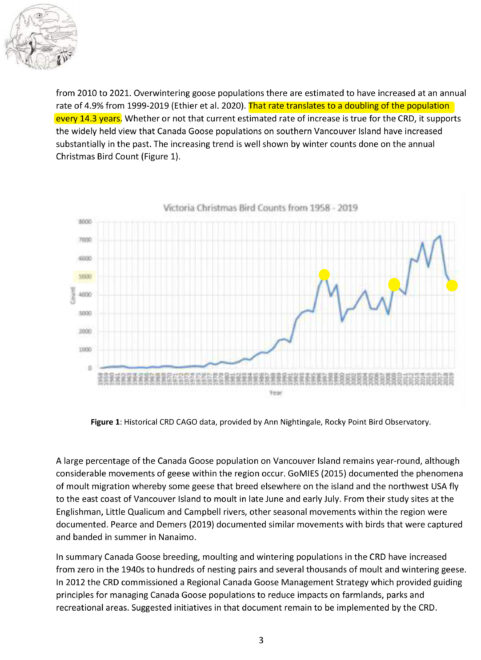
- The 2022 Mitigation and Population Monitoring document estimates the population at between 3500-7000 geese and suggests the population will double every 14.3 years. Data shows populations have remained stable for the past 24 years at roughly 5000 individuals.
- In 2015, the CRD culled 43 geese of a permit for up to 250.
- Ongoing egg addling has been conducted and 1,298 eggs were addled in 2021 between GoMIES, First Nations, and CRD crews.
- 2022, The decision was made to pass a Canada Goose Management Service to renew efforts to control local goose populations through an Alternative Approval Process, which effectively passed the proposal without public input and the need of 10% of CRD voters (roughly 33,000) to oppose the plan to stop it. 175 letters in opposition were received.
The Oct 12, 2022 Report to the CRD Board from staff to inform board members on the motivations to move forward with the Alternative Approval Process and a Regional Goose Management Service contained false information. Specifically, it states that the population of geese is doubling every 4.3 years. The actual number in the Guardians of the Mid Island Estuaries (GoMIES) Mitigation and Population Monitoring document developed for the CRD states the population is roughly doubling every 14.3 years, not 4.3. This mistake was the main source of urgency and panic motivating an immediate response to geese in the region by the CRD. It was repeated numerous times in the media and led to a misperception and misrepresentation of the issue at hand.

The Animal Alliance of Canada was very concerned about the decision making process at the CRD Board and Jordan Reichert presented to the Board of Directors Feb 8th, to notify them of this discrepancy of population growth numbers.
The CRD passed the bylaw to move forward with implementation with the Canada Goose Management Service, with only two directors in opposition. These two directors also raised concerns about the legitimacy of the Alternative Approval Process and the population numbers based on our work. Unfortunately, their colleagues rubber stamped the bylaw without addressing the false information in the staff reports.
Other concerns raised by the Animal Alliance of Canada in relation to the proposed Goose Management Service:
- Based on the CRD 2012 RCGMS and 2022 DAP documentation, identified stakeholders lack a zoologist or ornithologist, or CWS biologist who are knowledgeable about avian biology or the behaviour of local wildlife species, population dynamics, breeding strategies, taxonomic, interspecific and intraspecific competition, and other information potentially relevant to the issue. Regional biologists may or may not have adequate knowledge in this area.
- Current population numbers based on the GoMIES Goose Mitigation and Population Monitoring document are similar to those of 1999, 2009, and 2019. Despite some boom and bust in the population, there has been no appreciable increase in the CRD goose population based on current data since the mid 1990’s. There is no indication of an over-population of geese. However, social carrying capacity, which is context sensitive, may be the primary motivating factor of management options.
- The concept of the goose population doubling every 14.3 years and being “uncontrolled” is spurious. Claims that there were no geese prior to the 1970’s and then a constant increase that will continue to double ignores the biological carrying capacity of local populations which is well demonstrated by the boom-bust of the population currently. Culls directly interfere with this natural balance, and lead to the growth curve continuing indefinitely creating the need for remedial practices, and their costs indefinitely. In 2015, a cull took place of 43 geese. In the proceeding two years, the goose population reached it highest number recorded in 2017, before declining steeply as of 2021 data.
- Claims that non-migratory Canada Geese are not “native” as a non-local subspecies who arrived via anthropogenic means do not provide the full story. Canada Geese of other subspecies did occur in coastal B.C. and migrated along the Pacific Flyway, as they still do. They would have wintered where is suitable and it is reasonable that the CRD region of the South Island was a part of this.
- The 2022 DAP does not include a “cull” in its listed activities. However, this rhetoric was highly pervasive in media communications from the CRD during the period of the AAP. In fact, the only document that discusses culling is the 2012 Regional Goose Management Strategy document which is a part of the Feb 8th 2023, agenda package, but which was not a part of the documents present to the public on the Regional Goose Management Service Alternative Approval Site. This document is built upon population data from 2010 and provides false trajectories of the population which are not congruent with the most recent data provided in the GoMIES materials with up to date Christmas Bird counts. If this is the document the CRD board is operating from as the impetus for a cull and this entire project, it is an outdated and largely flawed starting point.
- The Alternative Approval Process is not reflective of public sentiment on the RGMS and the information provided is incomplete. There is an extremely high barrier to voting in opposition to a bylaw through this process. It is unlikely, that if 10% of CRD had to vote in favour of the motion it would have passed.
- The Electoral Response Form submission process required for opposition is convoluted, requiring multiple steps to submit a vote. Furthermore, one statement on the ERF states, “I declare that I have not knowingly made any false or misleading statements to another person with respect to this elector response form, action or other matter to which this elector response form relates.” However, there is evidence CRD representatives may have made false or misleading claims about the goose population and the need for a cull during the AAP process, yet there is a lack of accountability on this side of the matter.
- There is no evidence provided of widescale implementation of habitat modification techniques as recommended in the 2012 RCGMS. However, egg addling along with the natural carry capacity, besides one small cull which led to a temporary increase in the population, has led to a stable goose population with no justification provided for a further cull. If habitat modification was widely implement, more positive outcomes could be realized towards the projects goals of conflict reduction and mitigation.
The Animal Alliance of Canada will continue to hold the CRD accountable for passing wildlife policy based on false information shared with the public and its directors, and work to oppose a cull.
Thank you to all the concerned citizens who wrote to the CRD and who voted in opposition to the goose service. Please continue to follow our campaign and the opportunity for further actions.