The species we kill more of than any other is barely noticed by any of us.
Her death was slow. First the confusion of confinement, then the massive weight pressing down on all sides even as her ability to breathe ended. Suddenly fierce light, desperate to breathe, then a brief respite from the weight as she thrashed about, gasping, and then absolute darkness and the weight again, crushing her to death, a fate simultaneously experienced by tens of thousands like her. No one cared. She was just an animal.
We kill more of her species as a source of food than any other, mostly by pressure and asphyxiation, but if you ask any well-meaning animal advocate, they’ll probably say we kill more chickens for food than any other species. Not even close.
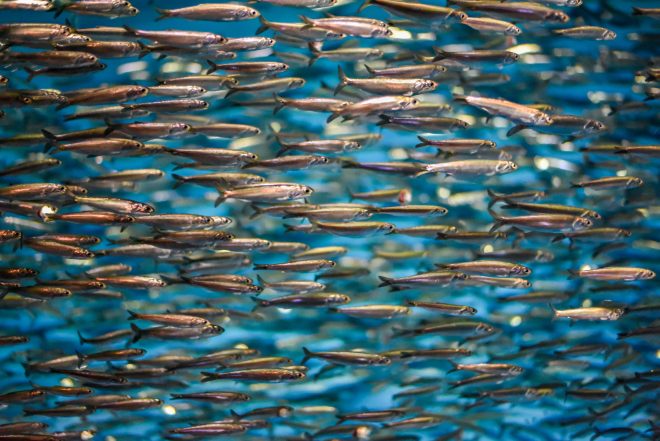
Scientists call her kind Engraulis ringens, and we know her as an anchovy. There are hundreds of billions like her who die so they can be marketed for their food value, each year, as compared to approximately 80 billion chickens. And 99 percent of her kind are not even directly eaten by us, although when they are, it is most visibly as a topping for pizzas – small fish we call anchovies. And within that one percent of the billions pulled from the sea, are those sold in tins and jars as fillets. But the vast majority of Peruvian anchovetas, to use their correct common name, are ground into fishmeal or fish oil used to feed farmed animals and farmed fish, only feeding humans, and our companion cats and dogs, indirectly. The oil occurs in numerous processed foods.
It’s estimated that, globally, roughly 2,400 chickens are killed every second to feed us. Peruvian anchoveta, the most heavily caught fish species on Earth, are also the most common individual species among the 1–2 trillion wild fish caught each year. Most are small marine fish such as anchovies, sardines, herring, capelin, and sprats. This total does not include bycatch—fish who are caught but discarded—estimated at about 10% of fish and commercial marine invertebrates such as shrimp and squid, who are caught for commercial use. Most of the small ones are fed to farmed fish—which now produce more seafood by weight than wild fisheries—as well food for pigs, chickens, and companions.
Why should this matter?
These are tiny fish with brains roughly the size of a sesame seed. Surely, they don’t feel pain, right? They live fast, reproduce in huge numbers, and usually end their short lives being eaten by almost anyone in the ocean bigger than they are—seabirds and marine mammals by the millions, and other fish by the billions.
It matters to us because we adhere to the precautionary principle: if in doubt, err on the side of compassion. Increasingly fish are recognized as being cognitive. They have an apparatus, the central nervous system (CNS) that facilitates reaction to stimuli, and they avoid that which is harmful, as do we. Unlike us, they can’t yell or flinch or otherwise show easily recognizable indications of suffering, beyond the fact that they seek, as do dogs, cats, and us, to avoid what harms and injures them.
Some neuroscientists argue that fish cannot truly feel pain because they lack the mammalian neocortex thought to generate conscious pain, while others counter that fish show behavioral and neurological evidence consistent with pain processed in different brain structures.
This argument echoes an older mistake in neuroscience. Birds were once thought incapable of complex cognition because they lack the mammalian neocortex—yet research has since shown that many birds have sophisticated cognitive abilities supported by different brain structures. Even animals who evolved along entirely separate evolutionary paths, such as the Octopus, are now widely recognized as capable of complex learning and problem-solving.
As we recognize World Day for the End of Fishing and Fish Farming, we only ask you to remember that most billions of animals we daily kill are fish, and yes, they are animals, and most of the scientific community agrees that they can suffer. Only a small minority of North Americans—roughly 3–5%—identify as vegetarian or vegan, while a much larger share, perhaps 15–30%, describe themselves as flexitarian, consciously reducing but not eliminating meat – or fish!
From anchovies to the largest predators, industrial fishing has removed an immense share of the ocean’s fish biomass in just a few generations—an impact measured not only in collapsing ecosystems, but in the countless individual lives taken from the sea.