The CCAC has closed its review of York’s primate lab without finding a single deviation. The university is using that finding to end the conversation. Here’s what the letter said, and here is why a compliance finding condemns the guidelines rather than clearing the conditions.
In May, we submitted a formal letter to the Canadian Council on Animal Care (CCAC) documenting severe welfare concerns at York University — including water deprivation, prolonged social isolation, and chronic implant infections. We did this to ensure the issues were formally recorded, not because the CCAC reliably acts to protect animals. The CCAC’s structure is built around institutional self‑assessment and self‑exoneration, not independent oversight.
Following over three months of consistent outreach, on August 12, Animal Alliance of Canada finally received a letter from Amir Asif, Vice-President Research & Innovation at York University.
It states that the Canadian Council on Animal Care has completed its review of York’s primate research program. In Asif’s words:
“the CCAC concluded that it did not find deviations from its policies and guidelines in the ethical use of animals in science at York University.“
And then, two paragraphs later:
“we do not believe that a meeting with senior University leadership would be productive at this time.“
Nine monkeys remain in the Behavioural Sciences Building. Nothing about this outcome changes anything for them.
We have published the letter in full below. We think everyone should read it. Here, we take it paragraph by paragraph, because the letter is the story.
What York University Actually Wrote to Us
1. On the review
“the concerns that have been raised regarding York’s animal research program have now been the subject of an independent review by the Canadian Council on Animal Care (CCAC), Canada’s national body responsible for overseeing and assessing animal-based science. Following its assessment, the CCAC concluded that it did not find deviations from its policies and guidelines in the ethical use of animals in science at York University.”
— Amir Asif, VP Research & Innovation, York University
The CCAC did not conclude that the nine macaques at York are well. It concluded that nothing done to them deviated from its policies and guidelines. Those are entirely different statements, and the distance between them is the whole argument.
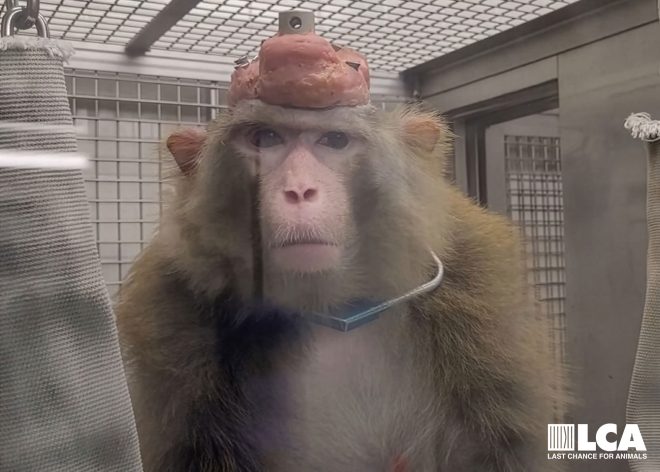
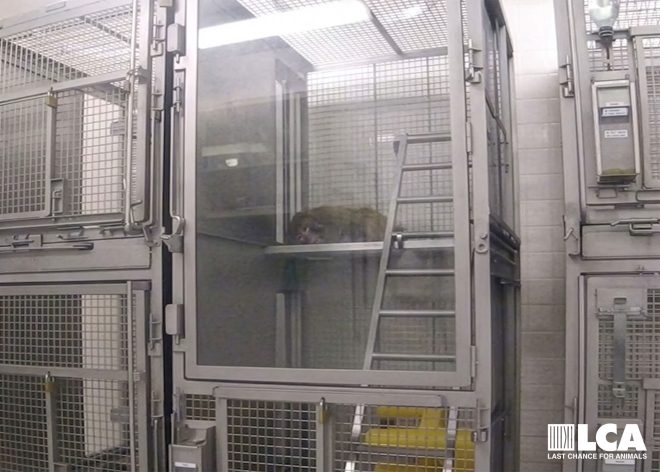
The undercover footage released by Last Chance for Animals, and the reporting by the Investigative Journalism Bureau that followed, documented macaques with metal head posts anchored into their skulls, animals pacing and swaying in barren cages, restraint collars, chronic implant complications, and water restriction severe enough that one macaque was recorded drinking his own urine. A primatologist reviewing the evidence for the complaint concluded the animals were suffering pain, anxiety and depression.
A review looked at all of that and found no deviation.
If cranial implants, restraint collars, decade-long confinement in barren caging and routine water restriction are all inside the guidelines, then York was never a rogue lab operating outside the rules. The rules are the problem. A finding of compliance here is not a defence of the lab. It is a confession about the standard.
2. On the word “independent”
Asif calls the review “independent.” We’ll come back to that word at length below, because it is carrying more weight in this letter than it can bear.
3. On continuous improvement
“We take seriously the responsibly that comes with animals in our care and we want to express our ongoing commitment to continuous improvement.”
This sentence sits one line after the claim that nothing deviated from any guideline. If the program is fully compliant, there is nothing to improve. If there is something to improve, name it. A commitment to continuous improvement that identifies no deficiency, sets no target, names no timeline and promises no public reporting is not a commitment. It is a closing formality.
4. On refusing to meet
“Given the completion of this independent review and the University’s confidence in the rigorous oversight that governs animal research at York, we do not believe that a meeting with senior University leadership would be productive at this time.”
York’s position is that an unpublished finding, from a body the university is certified by, has resolved a public controversy — and that there is therefore nothing left to discuss.
A university is an institution built on the premise that contested questions get worked through in the open. Two paragraphs earlier, the same letter says this:
“We recognize that animal research is a subject on which people hold strongly differing views, and we appreciate the time you have taken to express your perspective.”
York acknowledges the disagreement, thanks us for expressing it, and then declines to hear it. Those two sentences cannot both be doing honest work.
5. On the standard York claims to meet
“The University remains committed to conducting world-class research while upholding the highest standards of animal welfare and ethics”
York has made two claims here — world-class research and the highest standards — and we think both of them argue against the university rather than for it.
Animal Alliance of Canada’s position is that the highest standard in biomedical science today is innovative, human-relevant research. Not better cages for macaques. Not more attentive monitoring of animals with head posts bolted into their skulls. The highest standard is the science that has moved past needing them at all.
By that measure, what is happening in the Behavioural Sciences Building is not world-class. It is a methodology the rest of the field is actively working to leave behind.
This is not our characterization. It is the direction the major scientific institutions have already committed to:
- The FDA Modernization Act 2.0, passed with bipartisan support and signed into law in the Consolidated Appropriations Act of 2023, eliminated an 84-year-old federal requirement that new drugs be tested in animals, and authorized the use of alternative methods in their place.
- In April 2025, the FDA published a roadmap for a stepwise transition away from animal testing toward validated New Approach Methodologies — organ-on-chip systems, human cell-based models, AI and computational modelling, and real-world human data. The agency’s own stated rationale is that more than 90 per cent of drugs shown to be safe in animals go on to fail in humans.
- Weeks later, the National Institutes of Health announced an initiative to reduce animal use in NIH-funded research and prioritize human-based approaches, establishing a dedicated office to scale non-animal methods across its portfolio. The NIH’s own words for what it is expanding: innovative, human-based science.
- In March 2026, the FDA issued draft guidance on the use of New Approach Methodologies in drug development, while the NIH announced more than $150 million in funding to develop, validate and standardize human-based research methods.
Read York’s sentence again against that backdrop. The world’s largest biomedical funder has spent the last three years describing human-relevant methods as the innovation and animal models as the thing being phased out. York is using “world-class” to describe the latter.
We recognize this is a contested position and that many researchers argue animal models remain necessary in specific domains. But it is not a debate York can win by pointing at a compliance certificate, and it is not a debate that a CCAC assessment even attempts to enter.
It also matters that this is vision and perception research. Of all the fields in neuroscience, this is among the ones where human-based methods are strongest — because human participants can do something no macaque can. They can tell you what they saw. Seven-Tesla functional imaging, magnetoencephalography, high-density EEG, human psychophysics and eye-tracking, single-neuron recordings in consenting patients already undergoing clinical intracranial monitoring, and computational models of the visual system that have advanced enormously in the past decade.
A university that genuinely wanted to hold the highest standard would be moving its resources there, and saying so publicly. It would be positioning itself at the front of the shift instead of defending its place at the back of it.
Canada risks being left behind here, and York is a case study in how. There is a version of this story where a major Canadian university announces it is retiring its macaques and reinvesting in human-relevant neuroscience — and is covered internationally as a leader for it. That option is still on the table. York’s letter shows no sign the university has considered it.
“World-class” and “the highest standards” are not descriptions of what is happening in that building. They are a description of what York could choose to do next.
Why a CCAC Review Was Never Going to Protect These Macaques
Most Canadians reasonably assume there is a government agency inspecting research laboratories in this country. There isn’t.
The CCAC is a non-profit body that writes Canada’s national guidelines for animal-based science and certifies the institutions expected to follow them — York among them. It is not a regulator. Participation is voluntary, tied to eligibility for federal research funding through the granting councils. It has no statutory authority to compel compliance, levy penalties, seize animals, or shut a facility down.
So a complaint about a certified institution was assessed by the body that certifies it, against guidelines that same body wrote, and the outcome was announced to the public by the institution under review. That is the process York’s letter describes as “independent.”
This is the real problem with CCAC oversight. It relies on committees connected to the institutions they are supposed to be checking, and on information those institutions report about themselves.
We are not alleging bad faith by any individual involved. We are saying that no process arranged this way can produce a finding the public has good reason to trust — and that a system structurally unable to find fault is not evidence that no fault exists.
The result is predictable, and York’s letter is what it looks like: animals enduring water deprivation, prolonged isolation and repeated cranial surgeries remain in the same conditions, while the institution continues operating with the CCAC’s stamp of approval and declines to discuss it.
The nine
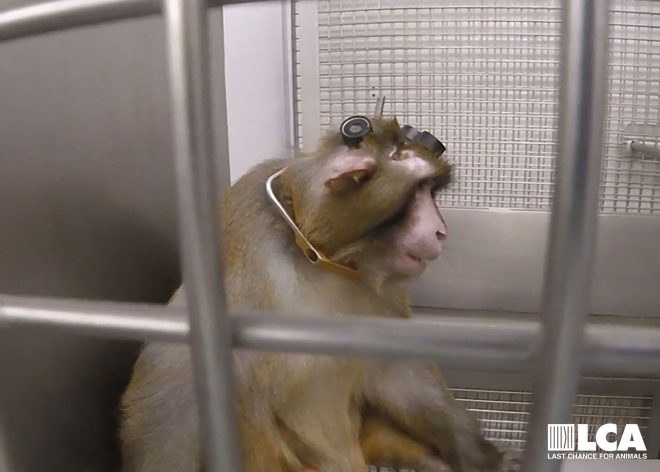
It is easy to lose them in the language of policies, guidelines and assessments. So it is worth saying plainly who this is about.
There are nine monkeys in the Behavioural Sciences Building at York University. Four males and five females. Their names, according to lab records documented in the investigation, are Bento, Kenning, Magneto, Monkey Do, Hannah, Liesl, Mini-Sass, Olivia and Virginia. Kenning — Kenny — has lived at York since 2015. He is one of the youngest.
Rhesus macaques are long-lived, highly social, intensely intelligent animals who in the wild live in complex troops with lifelong relationships. They recognize themselves and each other. They grieve. They form alliances and hold grudges. The capacities that make them scientifically attractive as models for the human brain are the same capacities that make prolonged isolation, restraint and confinement so damaging to them.
Nothing in York’s letter mentions any of them.
What needs to happen
Real accountability will not come from the CCAC. It will come from public pressure and political action.
We are calling for three urgent steps:
1. Pressure York University to end its use of nonhuman primates in invasive research and release the macaques currently in its care to a species-appropriate facilities.
2. Pressure the Ontario government to extend the same protections it granted to dogs and cats under Bill 75, ending invasive medical research on nonhuman primates province-wide.
3. Pressure the federal government to accelerate investment in non-animal research methods, including organ-on-chip systems, computational modelling, and human-relevant testing platforms that eliminate the need for primate models altogether.
York University has told us, in writing, that it does not consider a meeting productive. It is entitled to that position. It is not entitled to have the matter end there.
Take action now:
- Read York’s letter in full
- Send our action email
- Share this update
A CCAC assessment is not accountability. It is a procedural step that almost always ends in continued certification and continued suffering. York’s letter is what that looks like, in the university’s own words.