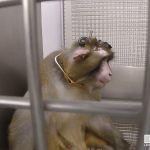
On September 2, the Jane Goodall Institute (Global and Canada) — founded by the late Dr. Jane Goodall to advance the protection and understanding of primates — issued a powerful public statement calling on York University to immediately retire the nine rhesus macaques used in invasive eye-tracking experiments and release them to a species-appropriate sanctuary. The Institute emphasized that modern, non‑animal research methods make this type of primate experimentation unnecessary and that continuing to use these monkeys is ethically indefensible.
Animal Alliance of Canada wholeheartedly supports the Jane Goodall Institute’s call. These nine rhesus macaques — whose treatment was exposed in Last Chance for Animals’ undercover investigation — deserve exactly what the Institute is urging: release to a sanctuary where they will never again be used for research or breeding.
Dr. Goodall spent her life showing the world that primates are intelligent, emotional, and deeply social individuals. That the Institute carrying her legacy forward is now urging York University to retire these monkeys is a powerful continuation of her life’s work — and a call Canada must heed.
Animal Alliance’s Advisory Group on Humane Science — a panel of scientists, veterinarians, and ethicists — stands ready to support the macaques’ relocation and to assist in ending their use in research and breeding.
This moment also underscores why monkeys must be explicitly protected under Ontario’s updated Animals for Research Act regulations. No animal should have to endure what these nine have. Adding non-human primates to the invasive medical research prohibition would help ensure no other monkeys in Ontario face invasive research like this again.
We join the Jane Goodall Institute in calling on York University to do the right thing — retire these monkeys to sanctuary.