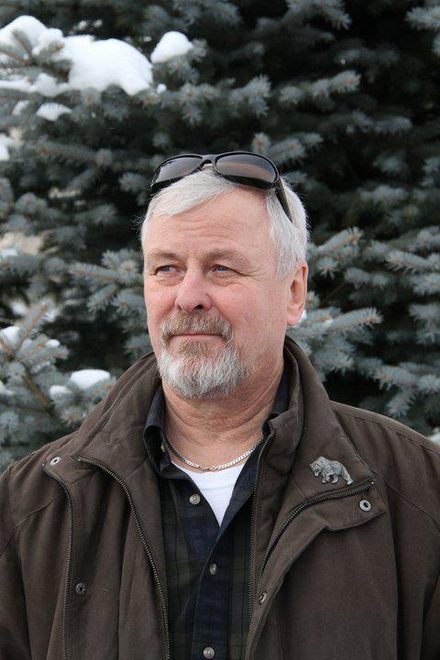
Written by: Barry Kent MacKay, Honourary Director, Animal Alliance of Canada
On August 6, 2026, I, and many others in the animal protection movement here in Canada, lost a dear and valued friend. So, however unknowingly, did many animals, when one of their most dedicated defenders passed away in Montreal, where he had lived for most of his life.
Georges Dupras was born in Quebec City on January 30, 1949, the youngest of three children, and is survived by his sisters. He grew up bilingual, although he used to joke that he was incompetent in both official languages—an example of the dry and gently self-deprecatory humour that was characteristic of him. His humour could be considerably more cutting when directed at anyone who was cruel to another person, or to a member of any other species.
Georges had been coping with serious illnesses for some time, yet he remained so actively involved in animal protection until the last days of his life that his death came as a shock. Illness had robbed him of much of his mobility, but it did not stop his activity on behalf of animals. His last email to me was on July 3, directing me to his Facebook posting opposing the abuse of animals at the Calgary Stampede.
Georges was part of what many of us think of as the birth of the modern animal protection movement in Canada: the reaction to the cruel excesses of the east coast “hunt” for newly born Harp and Hooded Seal pups on the ice floes of eastern Canada.
But Georges distinguished himself by his old-world charm, courtly manners and the fact that, unlike so many of the rest of us, he was a suit-and-tie type of businessman. He worked as a training coordinator and in loss prevention for the Hudson’s Bay Company before moving to risk management for Toys “R” Us in 1990. He retired in 2007.
His animal protection work began extraordinarily early. Georges opposed the east coast seal hunt from 1966, when the original Save the Seals Fund was established by Brian Davies, then an officer of the New Brunswick SPCA. Georges was only seventeen.
That was also how Anne Streeter first came to know him. Georges’ sister Joanna put Anne, then pregnant with her fourth child, on a committee of the International Fund for Animal Welfare (IFAW), which Davies founded after leaving the NBSPCA. Meetings were held at the Dupras home, and Georges eventually joined in.
Georges was,
Anne told me,
never one to carry a placard or do outrageous things. He was serious, sensible, well organized and above all incredibly reliable. He had a terrific sense of humor so was always fun to be with. We were a team. He was a great friend. I feel lost without him. He was a brother.
Ainslie Willock, herself so central to our movement, wrote:
When I was working to help protect bears, after working with IFAW to end the seal hunt, it was Georges who took time to take me across Quebec to meet with people there working to help bears. And, when it was my turn to work on the No Pets in Research campaign, it was Georges who was our contact to reach out to Quebec politicians. A life time of service to the animals. Georges is celebrated and greatly missed. We’ve all lost a wonderful friend of the animals.
Georges’ connection to the Animal Alliance of Canada was profound and went back to its beginning.
It was 1990,
wrote Liz White.
A number of us had been fired from the Toronto Humane Society and we were planning to start a new animal protection organization – Animal Alliance of Canada. We had no real resources except our determination and two key supporters, Anne Streeter and Georges Dupras. Both came through the Fund for Animal Welfare (IFAW)’s campaign to end the white coat seal hunt. Lead by the IFAW and a group of Canadians – Stephen Best, Barry MacKay, Ainslie Willock, Anne Streeter and yes- Georges Dupras. This intrepid team was instrumental in winning a massive victory for animals – the end of the white coat seal hunt’s primary markets, which saved thousands, tens or hundreds of thousands, of seal pups.
When Animal Alliance was founded both he and Anne Streeter agreed to sit on our Board and remained for over 30 years. Their advice helped form the direction of the organization, insisting that we fight for real, measurable results. They helped us reduce the number of puppies imported from the United States for commercial sale, stopped many pounds in Ontario from sending their dogs and cats to research and ended the agreement between the City of Winnipeg and the University of Manitoba meaning that the City pound would no longer provide researchers at U of M with pound dogs.
Both Georges and Anne lived in Quebec. Both worked to end the use of carriage horses in the City, an issue that was finally won. They were instrumental in our campaign to convince the City of Montreal to end its contract with the pound, Berger Blanc. An undercover expose by CBC’s d’Enquête exposed the terrible treatment of the animals impounded at the facility.
Steve Best, who was also there near the beginning, thought Georges deserved recognition far beyond the animal protection community.
The popular media did not publish feature obituaries about George Dupras,” Steve wrote. “They should have. Georges didn’t live, advocate, or work in the ‘public eye’ like many in the environmental and animal protection movements. Georges did something to which all can aspire.
Georges lived a good life: a life of meaning, loving relationships, worthwhile activity, and gratefulness for being alive. Quietly, persisting, Georges showed us, by example, how to live a good life. Essential, intrinsic to Georges’ good life was helping the animals with whom, he knew, we share everything.
Steve first encountered Georges through the seal campaign.
Georges’ and my paths paralleled in March 1973. Place? Îles de la Madeleine in the Gulf of St. Lawrence. There tens of thousands of female harp seals gather every year on the ice to give birth and see their pups slaughtered for their white coats.
Georges was a guest of Brian Davies, founder of the International Fund for Animal Welfare. Georges, when just 17 in 1966, worked as a volunteer to help Davies’ Save the Seal campaign. I was at the “Maggies” making a documentary for IFAW, Seal Song. It was about the harp seals, the hunt, and Davies’ campaign to end it.
The Save the Seal campaign was a break—a revolution, in fact—from the traditional animal welfare of the day. Then animal welfare groups were working with the government and industry to try to make the ‘baby seal hunt’ humane. Davies, then Director of the New Brunswick SPCA, after witnessing the killing, was having none of it. He said, “We need to end the bloody thing” and Georges signed on to ‘save the seals.’”
Their relationship continued for more than half a century.
Georges and I were not friends in the social sense. No birthdays or Christmas cards. We were advocates for a cause whose efforts often merged to increase mutual effectiveness. We spoke regularly by phone, sharing advice, exploring issues, and in recent years Georges’ health, something he never brought up. I did. Every call.
To me, a phone call from Georges was always welcome—true joy—best part of the day. Every call started the same way. Georges would apologize profusely for disturbing me and I would do my best to get through his thick head that his calls were never a disturbance. Then we’d talk, listen, and talk, rarely less than an hour.
As I remember Georges, I recall, too, Albert Schweitzer defending his beliefs, values, and advocacy. He said, “My life is my argument.” Georges’ life, too, is an argument for making a good life.
Yes, Georges’ life mattered to all who knew him, to the seals, to Montreal’s calèche horses, pets doomed to research, animals in labs, breeds targeted by legislation, animals in barns to name just a few.
It matters to me, personally, that Georges noticed and approved of my own efforts. Being thought well of by Georges Dupras is no small treasure.
Steve also recalled something that perfectly illustrated Georges’ modesty:
In April 2024 in WESTMOUNTMAG.CA, Georges’ wrote, “Thanks to the tenacity of Brian Davies and the initiatives of Stephen Best, the market for white coat pelts was dealt a serious blow by the European Economic Commission, which banned their import. Georges didn’t list his name along with mine and Brian’s. He should have.
Steve’s memories mesh with my own. I remember those long phone calls from Montreal, but also the good times we spent together. Georges, the perfect and generous host, once took me to the Biodome, an indoor zoo where belugas and other fauna especially ill-suited to captivity were nevertheless held in confinement. He worked tirelessly to stop the imprisonment of belugas in the Biodome, and now not only there, but nowhere in Canada are belugas or other cetaceans held captive.
He also took me to the Ecomuseum Zoo in Sainte-Anne-de-Bellevue, where animals native to the St. Lawrence region that could not be released to the wild were kept in spacious enclosures featuring natural habitat. We visited the Fauna Foundation on the South Shore as well. It was not open to the public, but Georges was clearly and warmly welcomed, and we were given the grand tour of the state-of-the-art rescue facility for chimpanzees, many of them suffering psychological harm resulting from earlier abuse.
Georges and I also attended conferences in Ottawa. We were there for the sixth meeting of the Conference of the Parties to the Convention on International Trade in Endangered Species of Wild Fauna and Flora (CITES), held from July 12 to 24, 1987, and for an annual meeting of the International Association for Bear Research and Management (IBA), where core themes included the effects of climate change on bears, particularly polar bears, and the peaceful resolution of conflicts between bears and people.
Georges’ interests in animals were broad and eclectic, and his curiosity seemed insatiable. He never married, although there was romance, and tragedy, in his life. But he remained very much a family man.
“He was,” his sister Joanna told me, “the family custodian of all documents and photos related to the ancestry of our family.”
He enjoyed antique shopping with his sisters, with a particular interest in objects that came with a known history.
And throughout it all there were the animals.
In addition to being a director of the Animal Alliance of Canada for more than thirty years, Georges served on the board of the Canadian SPCA. He protected all animals but had a particular passion for bears and was a member of the IBA. He defended the interests of animals before the Senate, addressing legislation that affected the interests of animals.
Georges was often asked by us and by other animal protection organizations to translate between French and English. He transported injured animals to places where they could receive help, from hedgehogs to bears—the latter driven nonstop from Quebec to the Bear With Us Centre for Bears in central Ontario.
He wrote many articles for newspapers and magazines, gave numerous media interviews about animal protection and advocacy, and spoke out on environmental issues large and small.
That list of accomplishments is impressive, but it still does not quite describe Georges.
Anne called him “serious, sensible, well organized & above all incredibly reliable.” Ainslie described “a life time of service to the animals.” Steve wrote that “Georges’ life, too, is an argument for making a good life.” Liz remembered the man who was there when Animal Alliance had little more than determination and who then spent more than thirty years helping to shape what it became.
They are all describing the same man.
This was a good and decent man: courtly, modest, kind, industrious and generous, possessing all those qualities to a degree well beyond the norm for humankind.
I miss him.
We all do.
