Peter Wohlleben will be at the Toronto Reference Library on Friday, March 23, 2018. Click here for event information.
By Alex Wilmot, Volunteer
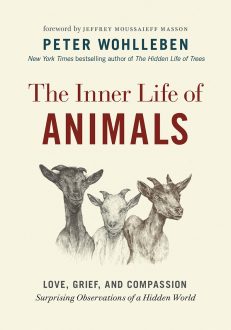
Following hard on the heels of his bestseller, ‘The Hidden Life of Trees’ – in which Peter Wohlleben presented his fascinating, albeit for the most part scientifically unproven, theories as to how trees communicate, co-operate with and care for each other – comes ‘The Inner Life of Animals’. In this latest book, Wohlleben – a forester who manages a large woodland reserve in Germany and has spent decades observing not only the trees but also the animals, both wild and domesticated, who share the area under his care – provides fascinating insight into the behaviours of these and other species and, through anecdotal and scientific evidence, seeks to open our minds to recognition of animals as emotional beings.
Although we have generally come to understand that animals – dogs, cats, apes, and dolphins, for instance – are sentient, we have yet to fully comprehend the depth of consciousness that they and other species – from reindeer to fruit flies, pigs to fish – possess, and the ways in which their emotions and consequent behaviours are similar to ours.
It could be, and often is, argued that most animals act purely on instinct, out of fear or need, but Wohlleben compels us to consider the probability that, for example, they are capable of kindness, bravery, empathy, curiosity, deviousness. That they feel shame, embarrassment, jealousy and grief – all characteristics and emotions that have long been assumed as particular to humans.
Pictures and videos abound in the media of the females of one species nursing the offspring of another, or of unusual animal friendships – chickens and cats, dogs and horses. Wohlleben, suggesting that cross-species adoptions are an indication that more than instinct is at play, cites the instance of a crow taking on the care of a stray kitten, feeding it – albeit with the kind of food favoured by its own species, such as insects and worms – and developing a bond that continued for many years.
A crow is also referenced in a chapter on how animals create pleasurable experiences for themselves – this particular bird videoed using a plastic lid as a sled, repeatedly carrying the lid to the top of a roof and sliding down on it. A chapter on animal altruism gives us the example of vampire bats, which regurgitate some of the blood they have consumed to feed hungry neighbours. An amorous rooster illustrates that animals are capable of figuring out devious methods to achieve their aims – in this case, frequent coupling with less than enthusiastic hens. And foxes are known to ‘play dead’ in order to bait unsuspecting prey.
Research into animal behaviour, says Wohlleben, reveals that some animals – pigs and chimps for instance – are able to identify an image in a mirror as their own, indicating consciousness of self, and that pigs can learn to recognize a name as theirs and respond individually when summoned to a meal. Ravens identify themselves by a particular call, a name, which is recognized by others in their group, and also use tone to convey attitudes, feelings – friendly, or not so much – towards other ravens.
Confronting the accusation of anthropomorphism, which is often leveled at those who liken animals to humans, Wohlleben points out that we are all animals and therefore it shouldn’t be that hard to imagine that our thought processes are similar. He goes on to suggest that our resistance to the notion that animals have the capacity to feel – both physically and emotionally – to recognize themselves, and to act in ways that indicate forethought and planning, makes it easier for us to accept inflicting pain and causing the misery that animals endure on factory farms and as hunted creatures.
Wohlleben writes with deep understanding, compassion and often humour about animals, not as a member of a superior species, but as a fellow being and, although he does not go as far as insisting that we refrain altogether from using animals as food, he strongly advocates that we consider the morality of our choices in light of what we now know.