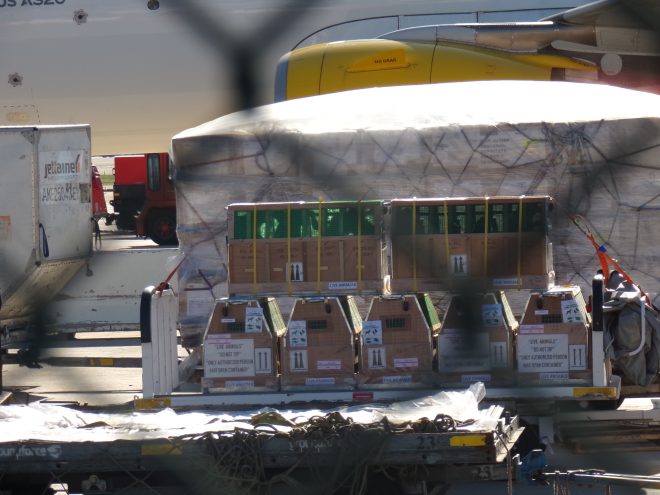
Please urge the Minister of Environment and Climate Change to suspend immediately all importing of monkeys from Cambodia.
Records received by Animal Alliance of Canada reveal ongoing violations of animal transport regulations during the importation of long-tailed macaques from Cambodia to Canada for use in laboratory experiments.
The violations, noted in documents received in response to Access to Information requests to the Canadian Food Inspection Agency, include transporting sick and injured monkeys, failing to have the monkeys inspected by a veterinarian before transport, and failing to secure proper permits before transportation. All of these are required under the Health of Animals Regulations. These violations are in addition to routine infractions of the Canadian Transportation Act.
Earlier this year, three flights, which were in violation of the Canadian Transportation Act, transported 1,980 long-tailed macaques from Phnom Penh, Cambodia to Montreal. During one of these flights, the monkeys were left onboard in crates for at least 45 hours before finally landing at Montreal-Mirabel airport. The Canadian Transport Agency acted upon these violations only after colleagues at Abolición Vivisección brought to the Agency’s attention that air carrier, SkyTaxi, had transported these monkeys without the required permits. For the suffering of these monkeys, the Canadian Transportation Agency issued a paltry fine of just $7,500. Contrast that to an $18,000 fine issued to WestJet just one week later for merely failing to give an audible announcement to passengers for the reason for a flight delay.
Sick and Injured Monkeys
The Health of Animals Regulations require that animals be certified to be fit for transport without enduring “undue suffering by reason of infirmity, illness, injury or fatigue during the expected journey.”
In 2020 and 2021, two loads of long-tailed macaques from Cambodia were deemed unfit for transport by CFIA inspectors. Although the specific condition of the monkeys was not recorded, examples of a lack of fitness for transport include animals with fractures, severe open wounds or those who are in shock or dying. One of these loads was also flagged for failing to be accompanied by an international veterinary health certificate, indicating that the animals were not seen by a veterinarian and may have been unfit for transport during loading. These monkeys also had a notation on their import permit indicating that they may have been re-routed, increasing the already lengthy time they were in transit, compounding their suffering.
Gruelling Journey to Life in a Canadian Lab
Unlike the U.S., Canada does not have transport regulations specific to primates. Instead, these sensitive animals fall under the category of ‘other animals’ and may be transported for up to 36 hours without food, water and rest.
Based on the information we reviewed and the recent case of the SkyTaxi flight that lasted over 45 hours, it is likely that many of these flights are exceeding the maximum allowed transport time.
Endangered Monkeys Require Greater Protections, Not Less
The rampant violations noted here are compounded by the fact that long-tailed macaques are listed as endangered by the International Union for Conservation of Nature. In November, 2022, the U.S. suspended all monkey shipments from Cambodia after the country was allegedly found to be capturing the animals from the wild and selling them as captive-bred: a violation of two U.S. federal laws.
Given that Cambodia appears to be flagrantly disregarding – and seemingly getting away with violating – Canadian regulations, how can there be any assurance that the country isn’t continuing to pass off wild-caught monkeys with those born in captivity?
No animal – wild caught or captive bred – should be forced to endure life in a research lab, even more so when that research has consistently failed to translate to humans. At a bare minimum, Canada has a responsibility to ensure it is not decimating populations of a wild, endangered species.
