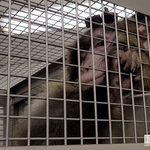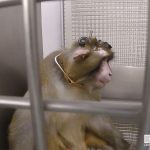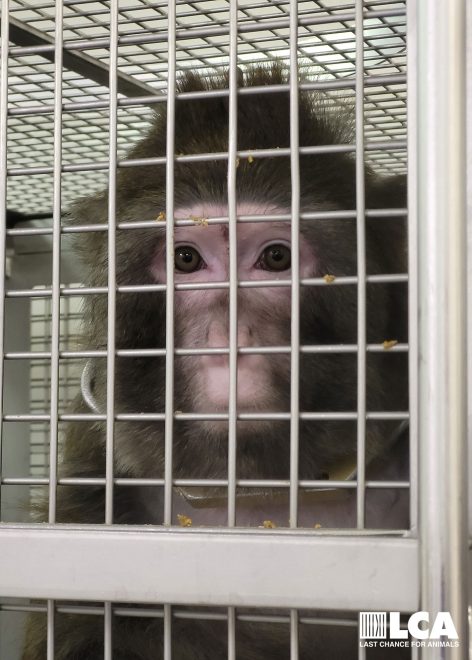
Records obtained by Animal Alliance of Canada reveal almost nothing about the primates at York University. They do show Ontario’s regulator found York’s animal facilities in breach of the law twice, then let problems linger for more than two years.
When Last Chance for Animals (LCA) released its undercover investigation into the treatment of nine rhesus macaques at York University, the public was left with an obvious question: where was the regulator?
In Ontario, the Ministry of Agriculture, Food and Agribusiness (OMAFA) is responsible for enforcing the Animals for Research Act. So we asked the ministry for its records. We requested York’s animal use reports, inspection and compliance records, records about the macaques and marmosets, York’s care protocols, and anything the ministry held about LCA’s investigation.
In late October 2026, the ministry released 23 records. Of 121 pages, it withheld 18 entirely and redacted many of the rest. They say almost nothing about the primates at the centre of LCA’s investigation. What they do show is a facility repeatedly found out of compliance; animals housed in conditions the ministry’s own chief inspector flagged, and a regulator that extended deadlines while those animals waited.
The primates are missing from the record
Our request was prompted by the macaques. Yet the primates are almost absent from what the ministry released.
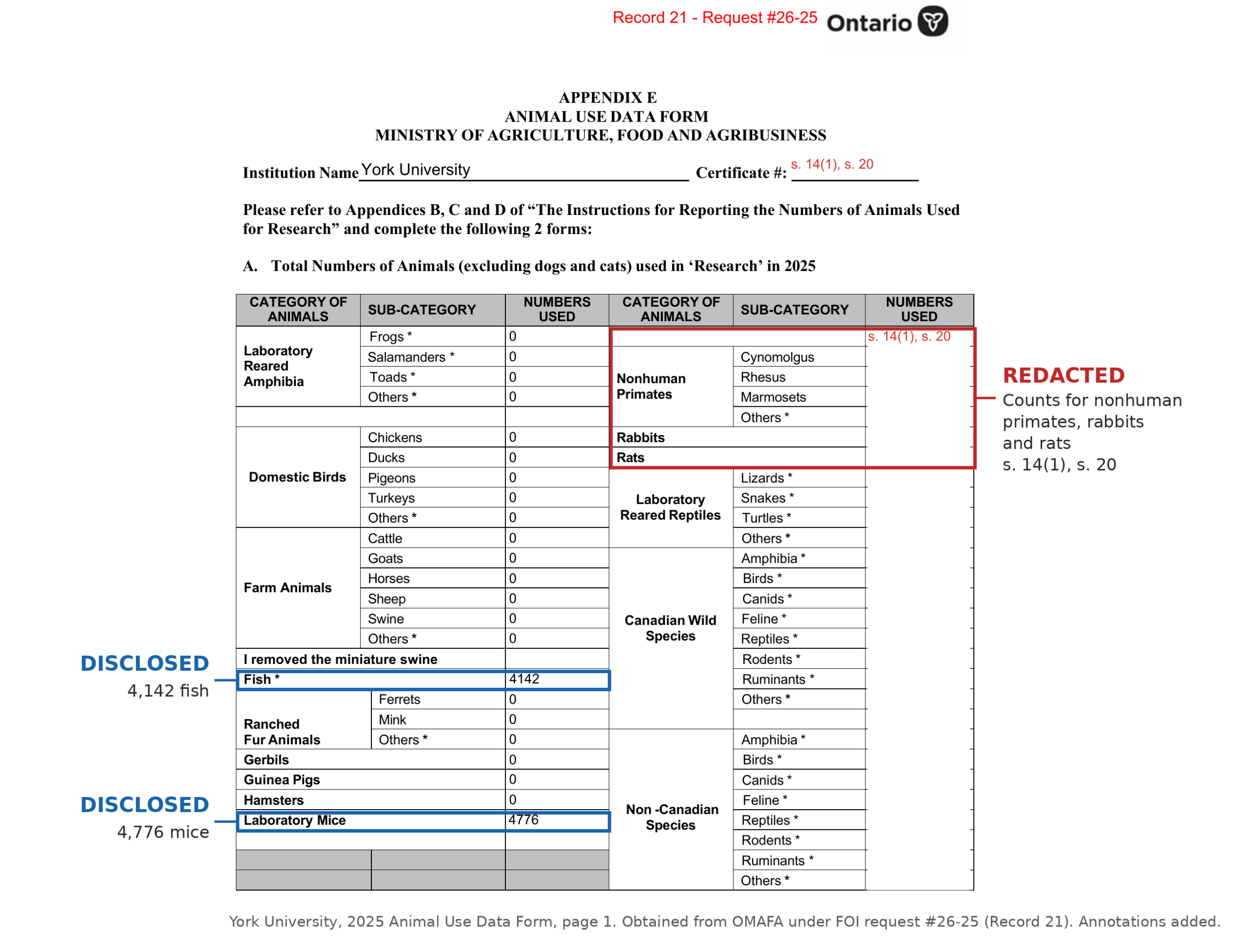
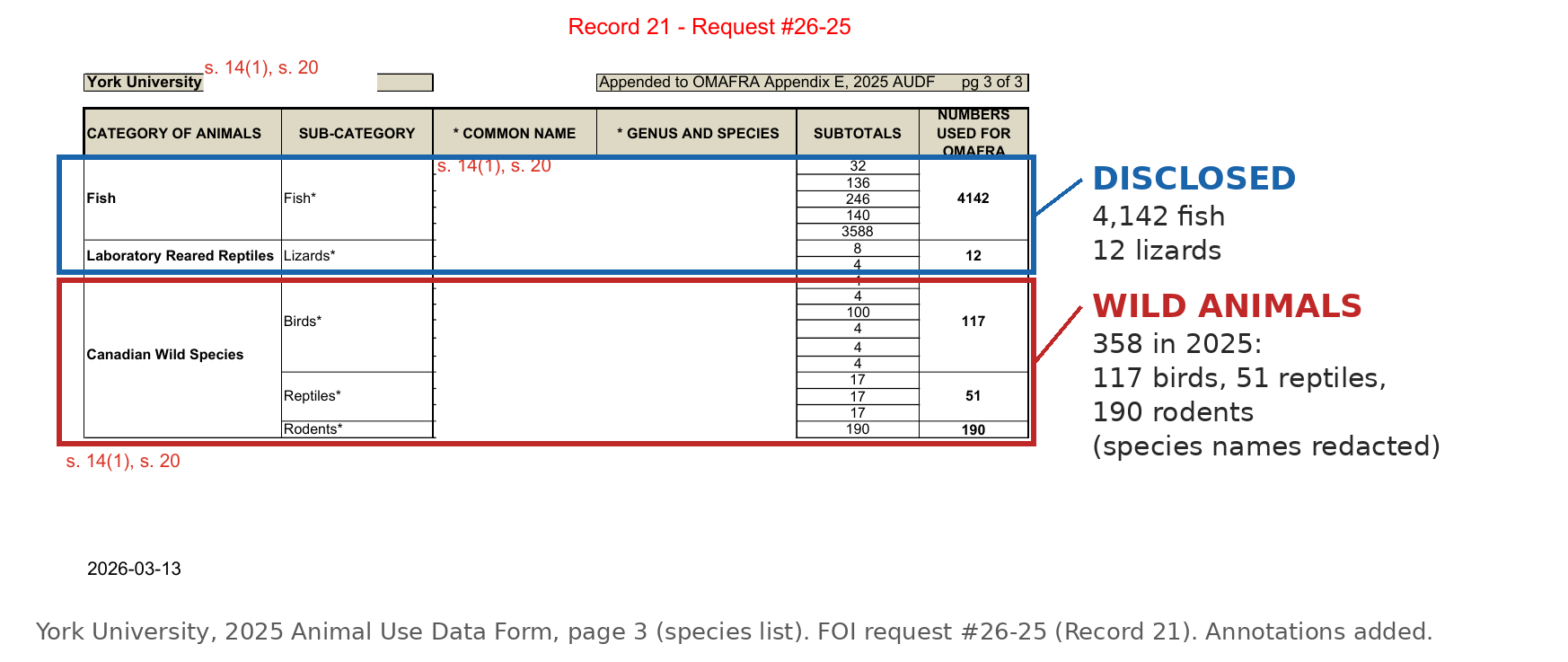
- Primate numbers withheld. York’s annual animal use reports disclose thousands of mice and fish: 9,288 animals in total in 2025. But the counts for nonhuman primates, rabbits and rats were redacted for both years, on the grounds that releasing them could threaten safety or interfere with law enforcement.
- Wild animals on the rise. York reported using 358 wild animals in 2025 (117 birds, 51 reptiles and 190 rodents), nearly three times as many as the 128 wild birds it reported in 2024. Their species names were redacted, and the records don’t say how the animals were obtained or what happened to them.
- No primate care records. No veterinary reports, incident reports, protocols or procedures about the primates were released, including anything on food or water restriction.
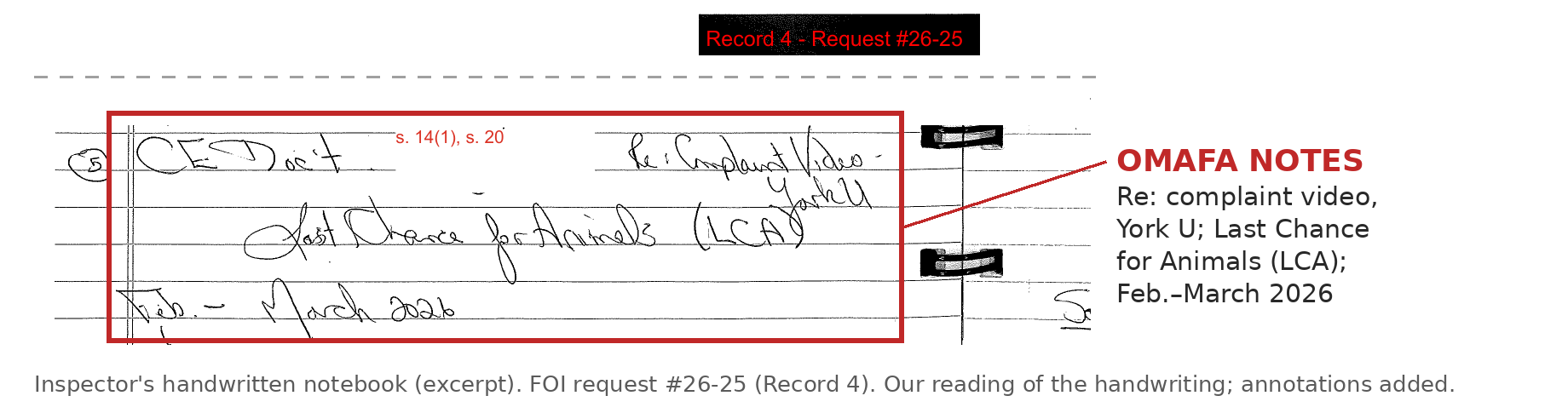
- No record of a response to LCA. The only references to LCA’s investigation are a few pages of handwritten notes by OMAFA’s Chief Veterinary Inspector for the Animals for Research Act, from early 2026. They mention video, whistleblower and marmosets, but no assessment, correspondence or action.
- A reportable incident, unreleased. York sent the ministry a “reportable animal welfare incident” report and related correspondence with the Canadian Council on Animal Care. Under CCAC policy, these incidents involve significant animal deaths or serious non-compliance that led to an activity being suspended. The report wasn’t released.
Inspections found animal housing conditions non-compliant
OMAFA inspected York’s animal facilities on September 19, 2024, and again on January 22, 2026. Both times, the ministry concluded York’s facility was “not in accordance with the Animals for Research Act.”
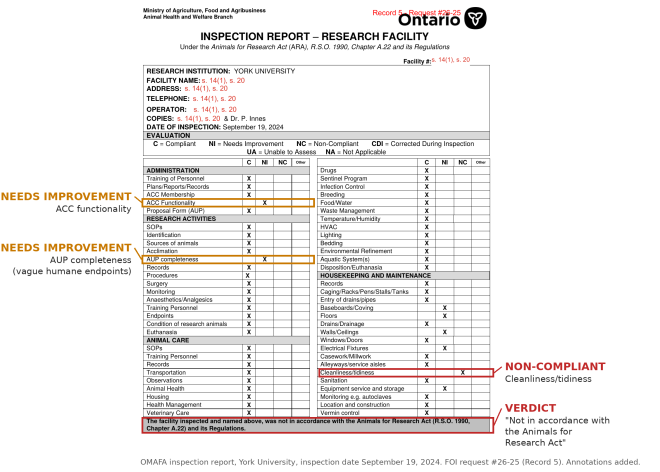
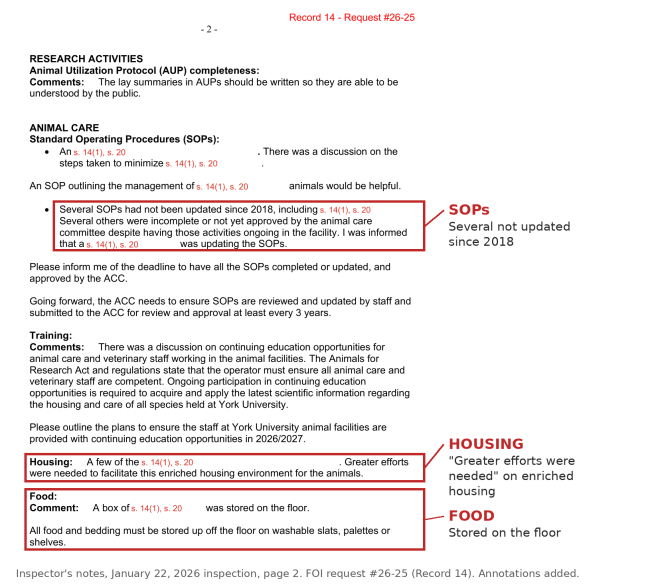
Several findings bear directly on the animals’ lives. In 2026, the rating for how animals were housed slipped from compliant to “needs improvement,” and the chief inspector wrote that “greater efforts were needed” to provide an enriched environment for them. Food was stored on the floor, though the ministry requires food and bedding to be kept off it. In 2024, cleanliness was rated non-compliant: in one room, mold was growing on the walls, ceiling, a chiller and a light lens. Sinks and racks were rusty and dirty, and exhaust grills needed more frequent cleaning.
The buildings themselves were also failing. In 2024, inspectors found a leak with exposed pipes that York’s own animal care committee had flagged nine months earlier, and extension cords in a wet environment. By 2026, floors had worsened to non-compliant, alongside unsealed baseboards, uncovered electrical outlets, a rusting walk-in cooler and clutter.
The ministry didn’t send the 2024 report to York until March 27, 2025, six months after the inspection.
A complaint about cages without food, sent back to York
In March 2025, the ministry received a complaint that cages at York were “often found out of food.” It also alleged unstable temperature and humidity, repeated flooding, intruders, and staff ignoring protective equipment rules.
Rather than investigate itself, the ministry asked York’s own animal care committee to investigate and report back. On the empty food hoppers, York explained that some mice grind their pellets to dust and eat from the cage floor, describing this as “stereotypic behaviour.” Stereotypies are widely recognized as a sign that an animal’s environment is failing them. York’s own explanation suggests the problem isn’t new: under some protocols, feeding is left to the research labs, and animal care staff watch for “low food/no food situations,” escalating “repeated non-compliance” to management.
On the other allegations, York’s reply put the word “complaint” in quotation marks and called one allegation “not true,” while conceding a staff member had not complied with the same rules. It acknowledged periodic flooding and an intruder.
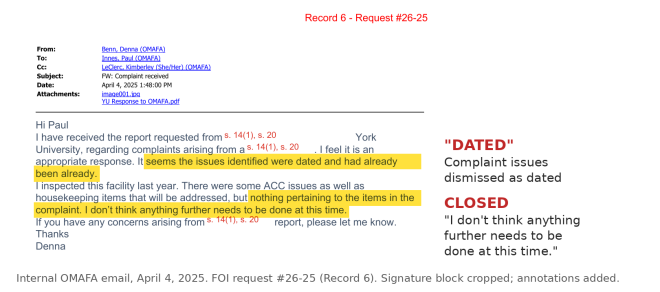
The chief inspector accepted York’s response within hours of receiving it. In an email to Dr. Paul Innes, manager of OMAFA’s Veterinary Science Unit, she wrote, “I don’t think anything further needs to be done at this time,” adding that her 2024 inspection had found “nothing pertaining to the items in the complaint.” That inspection had documented a leak. The records show no request for the temperature logs York says it keeps, and no further action on the complaint.
Repairs that dragged on
York’s response to the 2024 inspection arrived about eight weeks late. Photos confirming repairs came seven weeks after the ministry’s deadline, and the chief inspector noted that no further items had been completed. In January 2026, asked when it would fix floors, ceilings, baseboards and electrical fixtures, York answered item by item that it “cannot commit to timeline.”
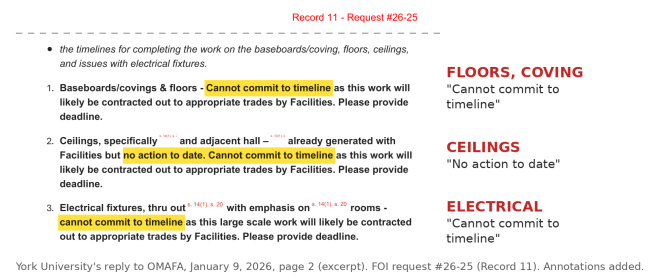
The ministry’s response was a new deadline: November 1, 2026, more than two years after the original inspection. Along the way, the records repeatedly accept a planned move to a new building as the reason to defer repairs. York told the ministry in April 2025 that the new facility would open in late summer 2025. As of April 2026, animals still remained in the problematic facility.
Oversight on paper
The chief inspector’s own reports describe an oversight system with serious gaps:
- Vague humane endpoints. In 2024, most protocols reviewed described humane endpoints, the point at which an animal must be removed from a study or euthanized, only in “general statements.”
- A conflict in monitoring. Post-approval monitoring was often done by one person who also supported the research teams being monitored, an arrangement the chief inspector warned “can lead to conflicts and divisiveness.”
- Outdated procedures. By 2026, several standard operating procedures hadn’t been updated since 2018, and some activities were ongoing without committee-approved procedures.
- Infrequent committee visits. York’s animal care committee visited facilities about 19 months apart, short of the Canadian Council on Animal Care’s expectation of at least once a year. Recusals from votes on members’ own protocols went unrecorded; the inspector wrote, “I’m assuming this was standard practice.”
- No ministry training. As of November 2025, the ministry’s own session on what the Act requires “has not been done at York.”
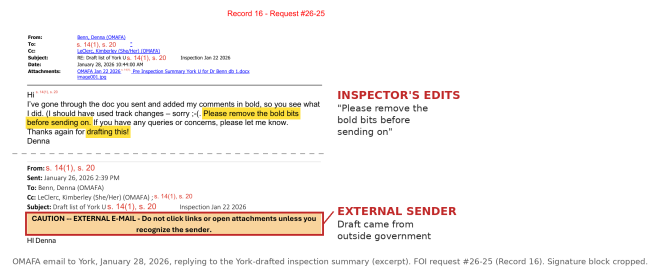
The documents also show York staff drafting the written summary of the January 2026 inspection findings from their own notes. The chief inspector edited it and asked York to “remove the bold bits before sending on.”
Oversight tools exist. They weren’t used.
OMAFA’s own guidance says it can issue warning letters, impose corrective action deadlines as short as one business day for high-risk welfare problems, suspend or revoke a facility’s registration after a hearing, and refer cases for prosecution. Our request asked for any non-compliance notices or corrective-action directives issued to York. None were released, and none were listed as withheld.
Instead, the records show a regulator relying on friendly reminders and extended deadlines. When York missed a document deadline after the 2026 inspection, the chief inspector wrote, “Please don’t panic about the rest.” When an occupational health test came back, she replied, “Wow – what a relief!!!!” What was tested, and why repeat testing was needed, was redacted in full.
The law is about to get stronger. From January 1, 2027, animal care committees must formally approve research before it begins, every committee must include a veterinarian, and corporate fines rise to as much as $1 million. Stronger rules mean little if existing ones aren’t enforced.
What we’re calling for
The animals in York’s facilities can’t file complaints or chase deadlines. They depend on a regulator willing to act, and these records show that regulator falling short. But the problem goes deeper than a failing inspection system. Even perfect oversight couldn’t make it humane to cut into monkeys’ skulls, implant devices in their brains and restrict their water, year after year. Some of these monkeys have been confined in York for up to 17 years.
Ontario has already moved to protect dogs and cats from invasive medical research. Primates, who are just as sentient, intelligent and capable of suffering, deserve the same protection.
Tell the Ontario government to add nonhuman primates to the regulations to prohibit harmful research on primates.
We’re filing follow-up requests for the primate records and will share what we learn.
About these records: Documents were obtained from OMAFA under Ontario’s Freedom of Information and Protection of Privacy Act (request #26-25), covering January 2025 to April 2026. Facility names are redacted, so the 2024 and 2026 inspections may concern different York facilities.